With AI moving from answering questions to doing tasks on its own, websites now face a new question: Are they ready to talk to AI agents, not just human visitors?
In the old days, optimizing a website was all about search visibility, speed of loading, mobile usability, and user experience. Another layer is agent readiness: can autonomous artificial intelligence systems find a website, understand the information it provides, authenticate securely, use available tools, and maybe even transact?
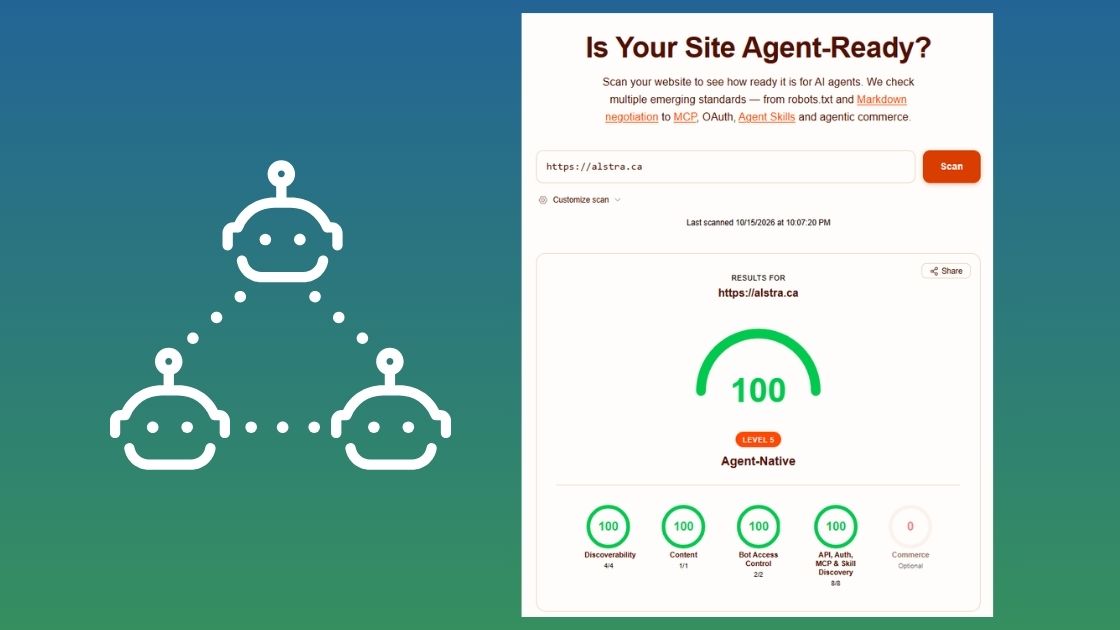
And Cloudflare’s Is It Agent Ready? provides a hands-on way to evaluate this nascent ability. The tool crawls the publicly available infrastructure of websites to analyze the support for emerging standards, and to discover improvements that could make digital services more accessible to AI agents.
Five dimensions of agent preparedness
As of October 2026, the assessment interface presents 22 selectable checks in 5 categories. They each look at a different aspect of AI agents' interaction with websites.
1. Findability: Can the AI Agents Find Your Resources?
4 checks now
Discoverability is the extent to which a website provides machine-readable ways to find its content and services.
The assessment checks robots.txt, XML sitemaps, HTTP Link headers, and DNS for AI Discovery (DNS-AID).
These mechanisms allow agents to discover what pages are available , what to do to crawl them , and what other resources exist . They do not rely only on visually browsing or parsing HTML .
Having a website with clear discovery signals allows agents to find relevant information more efficiently, and reduces unnecessary requests.
2. Content Readability: Are the Agents able to digest the information efficiently?
Current metrics: 1 check
The primary metric is Markdown content negotiation.
The scanner checks if a server can respond to an HTTP request with Accept: text/markdown with a proper Markdown representation.
Whereas HTML often has navigation elements , styling and scripts , Markdown can display information in a simpler structured format .
Cloudflare claims to have seen up to an 80% reduction in tokens for some Markdown serving scenarios. This may reduce processing costs and improve efficiency of information retrieval, although actual savings depend on the content and agent implementation.
We also propose to publish a llms.txt file, which could also help agents to find relevant content, but is outside of the main Markdown negotiation test in the scanner.
3. Controlled Access for Bots: Can Agents Access Content Responsibly?
Current metrics: 3 checks
Agent readiness is more than simply maximizing access. It also requires clear policies and mechanisms for controlling automated interaction.
The scanner looks at robots.txt, Content Signals, and Web Bot Auth for AI bot rules.
These mechanisms, jointly, address the question of what bots are allowed to access in terms of resources, how content owners can specify AI use preferences and how automated clients can identify themselves.
This dimension is important because organizations need to balance machine accessibility with intellectual property protection, security and operational control.
4. Protocol Discovery: Can Agents Communicate with Services?
Checks now: 10
Protocol discovery checks if a website or application offers standardized interfaces that AI agents can find in a machine-readable way.
We run the following checks today: API Catalogue, OAuth discovery, OAuth Protected Resource metadata, Auth.md, MCP Server Card, A2A Agent Card, Agent Skills, WebMCP, Agent Resource Discovery (ARD) and Personal Agent Protocol (Poppy).
These standards have different purposes. Tools and tasks are found using MCP and Agent Skills. Agents can learn of authentication requirements and request delegated authorizations via OAuth-related mechanisms. A2A and other discovery mechanisms are facilitating agent-to-agent and agent-to-service interactions.
This category is where the difference between a website an agent can read and a platform an agent can potentially use to do things lies.
5. Commerce: Can agents help with transactions?
Current stats: 4 checkmarks
The commerce category considers emerging transaction standards: x402, Machine Payments Protocol (MPP), Universal Commerce Protocol (UCP), and Agentic Commerce Protocol (ACP).
These protocols explore how AI agents can discover commercial capabilities, process payments and participate in buying workflows.
They are particularly relevant to e-commerce platforms, marketplaces and paid digital services.
In Cloudflare’s posted description of scoring, commerce checks are scored separately and do not affect the overall readiness score. Their presence should therefore be understood as a sign of growing transaction capabilities, and not as a general requirement for all websites.
Interpreting the Readiness Score
It’s a matter of sending requests to a website and verifying that relevant standards are supported and if relevant endpoints are supported. It then provides a summary readiness assessment, personal check results and actionable recommendations.
However, agent readiness is not the same as passing as many checks as possible.
A documentation website might care about discoverability and markdown availability, while an API platform might care more about stronger authentication and protocol discovery. Transaction standards could also be of benefit to an e-commerce platform.
The scanner provides various modes of assessment, e.g the Content Site and API / Application to make the assessment more relevant to the purpose of the website.
The result is best interpreted as a technical readiness metric, not a validation that AI agents can successfully perform all real-world tasks.
What can we learn from current adoption metrics?
Cloudflare Radar tracks the adoption of agent-related standards by major websites. The October 5, 2026 update reports coverage of 111,711 successfully scanned domains from an initial population of the top 200,000, minus category exclusions and scan limits.
Cloudflare’s original analysis from April 2026 also revealed the state of early adoption: 78% of the sites analyzed had a robots.txt file, but only 4% declared Content Signals preferences and 3.9% passed Markdown negotiation checks.
These April percentages are historic benchmarks, not the latest October adoption rates. However, they do indicate a significant divergence: a website might use traditional web infrastructure but not support newer agent-specific mechanisms.
From Readiness Scores to Real-World Performance
The most practical approach for organizations is to use both technical scans and practical agent testing.
First, make an inventory of your existing site, determine which checks apply, and prioritize the most important fixes. After you’ve implemented it, evaluate again to gauge technical progress.
Organizations should also test real tasks like retrieving a product specification, finding policy information, accessing an authenticated service, or completing a permitted workflow.
Other operational metrics that can be used include task completion rate, retrieval accuracy, response latency, token consumption, authentication success, and transaction reliability.
These measurements are not a substitute for the scanner; they are a complement to it: technical compatibility tells us what infrastructure is available, but task-based testing tells us if that infrastructure actually works for users.
Summary: Digital Infrastructure Adds Another Layer of Agent Readiness
As AI agents become more powerful, organizations will need to design digital services for human interaction as well as machine-driven workflows.
Cloudflare’s assessment offers a useful starting point by assessing discoverability, content accessibility, bot access control, and protocol discovery and commerce capabilities.
The bigger point is that agent readiness isn’t one thing or one file. It’s a mix of structured information, interoperable protocols, good control of access, and reliable services.
The next wave of competitive websites will not only be discoverable by AI, They will be designed to work with AI in a safe, efficient and productive manner.
References: Is It Agent Ready? · Cloudflare Agent Readiness · Cloudflare Radar AI Insights